
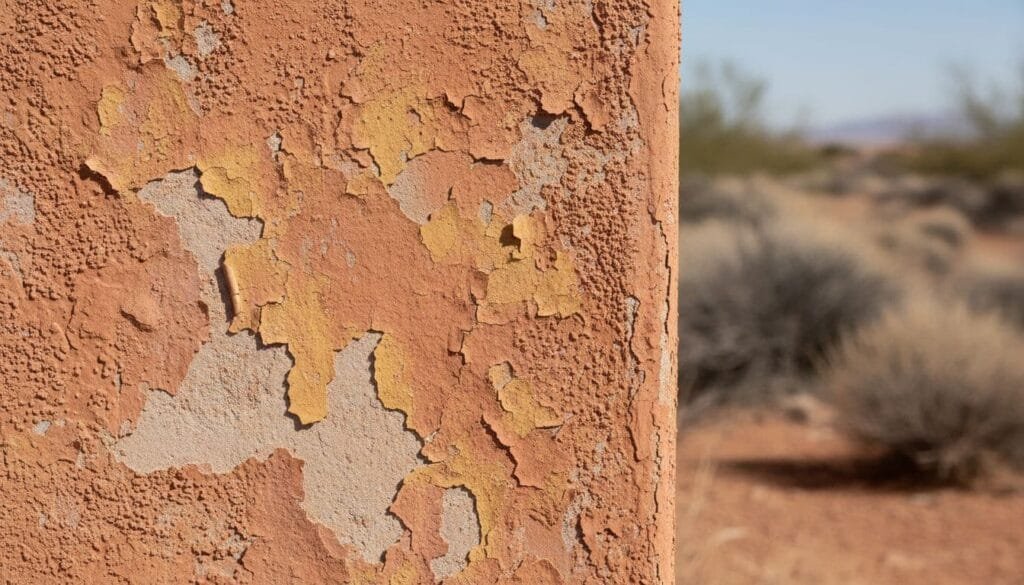
The Victorville sun is no joke. You wash your car, and it looks faded again in a year. Your house paint takes the same beating, just silently.
Many homeowners ask how long high desert exterior paint should last. Five years? Ten? Longer? The honest answer is, it depends, and the brochure numbers often do not match High Desert reality.
This guide breaks down real lifespan ranges for stucco and wood, how Victorville’s UV, wind, dust, and temperature swings chew up paint, and what you can do to stretch a paint job a few extra years.
Why High Desert Exterior Paint Fails Faster
Victorville and the surrounding High Desert are tough on coatings. Several things attack your paint at the same time.
1. Intense UV and sun
High UV breaks down the paint resin that holds everything together. Color fades, the surface gets chalky, and the film becomes brittle. Dark colors soak up more heat, so they age even faster.
2. Big day-night temperature swings
In Victorville, a summer day can hit triple digits, then cool way down at night. Stucco, wood, and metal expand and contract. Paint has to flex with those movements. When it cannot, you get cracking and flaking.
3. Wind and dust
Afternoon winds carry fine grit. That dust blasts the surface, wears away the finish, and works into tiny cracks. Over time, the film thins and loses protection. Dust also makes surfaces dirty, which reduces adhesion for any future repaint.
4. Low humidity
Dry air pulls moisture out of paint quickly. If the painter does not adjust technique and timing, the paint can dry too fast on the surface and not cure properly. That weak film will not last as long.
Put all that together, and you can see why generic “10 to 15 year” claims rarely line up with what you see in Victorville, Hesperia, or Apple Valley.
Realistic Exterior Paint Lifespan In Victorville
Here are honest ranges for a well-prepped job, using quality products, in typical High Desert exposure.
| Surface and paint type | Typical lifespan in Victorville |
|---|---|
| Stucco with standard 100% acrylic | 5 to 7 years |
| Stucco with quality elastomeric coating | 8 to 10 years |
| Wood siding with 100% acrylic | 5 to 7 years |
| Wood fascia, trim, exposed eaves | 4 to 6 years |
| Dark colors on any surface | Subtract 2 to 3 years |
These are realistic ranges, not promises. Prep, product line, color, shade, and wind exposure can swing the numbers.
Stucco Homes: How Long Your Paint Really Lasts
Most homes in Victorville, Apple Valley, and Adelanto are stucco. Stucco handles desert heat fairly well, but it still needs the right coating.
Standard acrylic paint on stucco
A good 100% acrylic exterior paint on stucco can give:
- About 5 to 7 years on sun-exposed sides
- Maybe up to 8 years on shaded or protected walls
What shortens that life:
- No pressure washing before painting
- Skipping primer over chalky surfaces
- Thin coverage or only one coat
- Dark, heat-absorbing colors
Watch for these early warning signs:
- Color looks washed out compared to the back or shaded side
- White powder (chalking) on your hand when you rub the wall
- Hairline cracks that keep coming back
- Small peeling patches near window sills or parapet caps
If you see those, the coating has started to fail, even if it is not falling off yet.
Elastomeric coatings on stucco
Elastomeric is a thick, flexible coating often used on stucco. It stretches, so it can bridge many hairline cracks and tolerate movement from heat and cold.
In High Desert conditions, a properly applied elastomeric system on stucco can give:
- About 8 to 10 years in normal sunlight
- Sometimes 10 to 12 years on lighter colors in protected areas
For that to happen, the painter has to:
- Wash and remove chalk
- Spot prime repairs and bare areas
- Hit the manufacturer’s required film thickness, usually with 2 heavy coats
- Use compatible primers and topcoats
Elastomeric is not magic. If someone sprays a single thin coat over dirty, chalky stucco, it may fail in 4 or 5 years, just like a cheap repaint.
Wood Siding, Trim, And Fascia: Shorter Lifespan
Wood moves more than stucco. It swells and shrinks as temperature and moisture change. That movement pulls on the paint film.
What to expect on wood
With good prep and quality acrylic:
- Wood siding can go 5 to 7 years between full repaints
- Fascia boards, rakes, and eaves often need fresh paint every 4 to 6 years
High-exposure areas, like south and west-facing fascia in Spring Valley Lake or open lots in Hesperia, fail faster.
Common reasons:
- Sun cooks the top edge of fascia
- Old, cracked caulking splits and lets water creep in
- Previous painter did not prime bare wood spots
- Old oil-based layers under new acrylic move and crack
Look for:
- Hairline cracks along board joints
- Peeling on the bottom edges of fascia and trim
- Dark staining on raw wood where the coating gave up
If you catch it early, a spot repair and repaint of trim might buy time before a full house repaint.
Color, Sheen, And Product Quality Matter
You can add or lose years based only on product choices.
Color choice in High Desert sun
- Dark colors (deep browns, charcoal, navy) get very hot, especially on stucco and metal doors. They often fade and chalk in 3 to 5 years in full sun.
- Medium and light earth tones hold better and look less faded over time.
- Bright reds and yellows are prone to fast fading in Victorville UV.
If you love dark trim or doors, be ready to repaint those areas more often than the main body color.
Sheen and surface type
- Flat or matte hides stucco flaws and hairline repairs, but can chalk sooner.
- Low-sheen or satin on stucco gives a bit more washability.
- Satin or semi-gloss on trim and doors helps with dust and grime, since it cleans more easily.
Glossy finishes show dust more but stand up better on handrails, metal doors, and high-touch areas.
Product quality and chemistry
Try not to judge paint only by price. Look for:
- 100% acrylic exterior formulas
- UV-resistant pigments and good color retention ratings
- Strong warranty from a major manufacturer
Cheaper paints often have more filler and weaker binders. In Victorville weather, that can mean a 3 to 5 year job instead of 6 to 8.
Should You Repaint Now Or Wait?
If the house still “looks ok” from the street, it is tempting to wait another year. The question is how the coating is doing up close.
Use this simple check:
- Rub your hand on a sun-facing wall. Heavy white powder means the paint is breaking down.
- Look at the south and west-facing trim and fascia. Any peeling, cracking, or exposed wood is a sign to act soon.
- Check caulking around windows and doors. If it is split or missing, water can get behind the paint film.
If you catch failure early, the painter can sand, prime, and repaint over a mostly sound surface. If you wait until large areas peel, you pay more in prep and repairs.
Think of repainting like changing tires. Waiting until cords show costs more than dealing with worn tread.
Simple Ways To Stretch Your Next Paint Job
You cannot change Victorville’s sun and wind, but you can help your coating last closer to the high end of the ranges.
- Pick sane colors: Lighter, earth-tone body colors with mid-tone trim age better than very dark schemes.
- Invest in prep: Washing, scraping, priming, and fixing hairline cracks make more difference than one extra coat alone.
- Use quality 100% acrylic or elastomeric where it makes sense: Good chemistry handles UV and temperature swings better.
- Rinse your house once a year: A light hose rinse or soft wash removes dust that can wear on the film.
- Spot fix early: Touch up peeling fascia or bare stucco patches right away, so failure does not spread.
Final Thoughts: Plan For The Climate You Live In
High Desert homes live under harsh light, strong wind, and gritty air. Expecting exterior paint to last forever sets you up for disappointment.
If you plan for 5 to 7 years on standard acrylic and up to 8 to 10 years on well-done elastomeric stucco systems, you will make better choices on timing, products, and budget. Take an hour to walk around your house this week, check the sunny sides and the trim, and decide if it is smarter to repaint now or next season. Your future self will be glad you did.